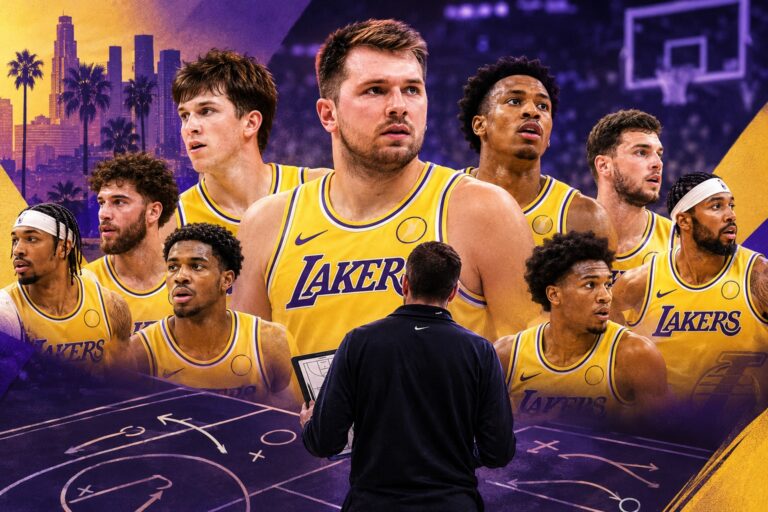


I compared last season’s Lakers lineup with individual role profiles and checked the relevant player-production comparisons against NBA season statistics. I mostly used BBal-index including their stable lineup tool for this. I used the stable lineup tool to see what lineup combinations worked last season.I used the stable lineup tool because it gives better results, especially for lineups that where not played much as it stabilizes player or team hotstreaks. Other than that I made a custom percentile for guards and another one for bigs to show and see how good certain players where. This is better for a comparison between guards/wings and bigs. As for example a big man will always be in the top percentile for rim protection if you also include guards. Doing it this way we can better compare the players together. The result is an 11-man rotation with nine different five-man combinations. To start the season.
Now making a full rotation is hard enough as it is, especially this early in the season, so this is very likely going to be wrong and will likely not be the rotation at the end of the season. Part of this is lineups I want to see, see if and how they work so we can make adjustments later. Keep that in mind when reading.
Cameron Carr and to a lesser extent Adou Thiero were harder to place into this rotation as there is not that much data for them yet, and Adou is very likely to have improved. I opted to start with a small role for both to see how they do and ease them into the NBA season a bit more, this is in part because we have incomplete data, I can see why someone would play them more, but at this point in time I decided not to go for that yet. You could very easily increase their minutes by playing subbing them in slightly earlier and out slightly later. And by making other players play slightly less. They would also be the first two guys to get more minutes in case of injury and will play all garbage time minutes of course.
Some lineups have convincing Lakers precedents. Others are more experimental, particularly the groups without Luka and the brief combinations that sacrifice size or spacing.
That distinction matters. A useful comparison should explain both why a lineup might work and what prevents it from being a direct replacement.
The minutes distribution
This is a full-strength plan for a competitive, 48-minute game.
| Player | Minutes |
| Luka | 34 |
| Reaves | 34 |
| Kessler | 34 |
| Grimes | 30 |
| LaRavia | 22 |
| Mamu | 20 |
| Sexton | 20 |
| Thybulle | 20 |
| Ziaire | 12 |
| Carr | 8 |
| Thiero | 6 |
Kevon Looney, Jarred Vanderbilt, Jaden Hardy and Bronny James remain matchup and availability alternatives rather than automatic members of this particular rotation. Looney specifically will probably play as he is the only real backup center we have, if you don’t count mamu who is a pf/c not a pure C obviously. I thought about putting him in the rotation for 6-8 minutes to see how he would do, but starting out with a 12 man rotation seemed a bit much, so I decided to not use him in the base rotation for now and to see how mamu would do at first. Though we could still use him in a situation where the opponent plays bigger for example, or if we really need more rebounding.
Kessler’s 34-minute allocation is substantial. It assumes unrestricted availability and should not become an obligation on every regular-season night. Looney is the natural alternative when workload or the opposing frontcourt requires another center. Reducing Kessler’s minutes to like 30 and playing Looney for 8 minutes could be a viable path.
The full minute-by-minute rotation
The first and third quarters use the same schedule. The second and fourth quarters also match.
In the tables, Mamu means Mamukelashvili and Ziaire means Ziaire Williams. Positional columns describe lineup slots, not mandatory defensive assignments.
Substitution times are targets for the nearest available dead ball, obviously this will end up being a bit more fluid.
First and third quarters
| Clock | Lead guard | Guard | Wing | Forward | Center |
| 12:00-11:00 | Luka | Reaves | Grimes | LaRavia | Kessler |
| 11:00-10:00 | Luka | Reaves | Grimes | LaRavia | Kessler |
| 10:00-9:00 | Luka | Reaves | Grimes | LaRavia | Kessler |
| 9:00-8:00 | Luka | Reaves | Grimes | LaRavia | Kessler |
| 8:00-7:00 | Luka | Reaves | Grimes | LaRavia | Kessler |
| 7:00-6:00 | Luka | Carr | Grimes | LaRavia | Kessler |
| 6:00-5:00 | Luka | Carr | Grimes | Mamu | Kessler |
| 5:00-4:00 | Luka | Carr | Grimes | Mamu | Kessler |
| 4:00-3:00 | Luka | Carr | Grimes | Mamu | Kessler |
| 3:00-2:00 | Reaves | Sexton | Thybulle | Ziaire | Mamu |
| 2:00-1:00 | Reaves | Sexton | Thybulle | Ziaire | Mamu |
| 1:00-0:00 | Reaves | Sexton | Thybulle | Ziaire | Mamu |
Second and fourth quarters
| Clock | Lead guard | Guard | Wing | Forward | Center |
| 12:00-11:00 | Reaves | Sexton | Thybulle | Ziaire | Kessler |
| 11:00-10:00 | Reaves | Sexton | Thybulle | Ziaire | Kessler |
| 10:00-9:00 | Reaves | Sexton | Thybulle | Ziaire | Kessler |
| 9:00-8:00 | Reaves | Sexton | Thybulle | Thiero | Kessler |
| 8:00-7:00 | Luka | Sexton | Thybulle | Thiero | Mamu |
| 7:00-6:00 | Luka | Sexton | Thybulle | Thiero | Mamu |
| 6:00-5:00 | Luka | Sexton | Grimes | Thybulle | Mamu |
| 5:00-4:00 | Luka | Reaves | Grimes | LaRavia | Mamu |
| 4:00-3:00 | Luka | Reaves | Grimes | LaRavia | Kessler |
| 3:00-2:00 | Luka | Reaves | Grimes | LaRavia | Kessler |
| 2:00-1:00 | Luka | Reaves | Grimes | LaRavia | Kessler |
| 1:00-0:00 | Luka | Reaves | Grimes | LaRavia | Kessler |
Which player comparisons actually hold up?
Before comparing five-man groups, the individual analogies need to be defined carefully.
Mamu at power forward can fill a Rui-like spacing job
There is a legitimate offensive comparison here, but it should not be overstated.
Hachimura shot 44.3% from three in 2025-26, while Mamu shot 38.9%. Both provide evidence for a perimeter-shooting role, but those are not equivalent shooting results. Mamu though had a lower shot quality that Rui, so those percentages could be a lot closer than it seems right now.
With Kessler at center, I would use Mamu to occupy some of the spaces Rui occupied: outside the paint, available when Luka draws help, and capable of attacking the next advantage.
That is a comparison of offensive responsibilities. It does not establish equal shooting gravity, the same shot-creation ability or interchangeable defensive assignments, those are things we would need to see more off.
Mamu also changes the structure when he moves to center. At that point, he is not simply reproducing Rui’s forward role. He is replacing a conventional center with a different offensive skill set. Though it could work somewhat similar to the small ball lineups we played in the past.
Collin Sexton kind of is a Luke Kennard replacement role wise, though he is also brings more secondary-creating.
Here are some of their stats.
| Player | Offensive role | Catch-and-shoot 3-point percentage percentile |
| Sexton | Primary ball handler | 94.8 |
| Reaves | Shot creator | 74.3 |
| Kennard | Off-screen shooter | 99.1 |
These are the custom guard/wing percentiles, not actual shooting percentages. When looking at this the 74.3% from reaves seems fairly low, but that is still 40.4% in catch and shoot situations, while shooting harder shots.
Though Sexton isn’t an amazing defender, he is better than what Kennard brought so that is a plus. For example Sexton was 38.6 percentile among guards/wings in perimeter isolation defense. 77.2 percentile in off ball chaser defense and 69.5 in defensive playmaking. While Kennard was 16th percentile in perimeter isolation defense, 22.4th percentile in defensive playmaking and 68th percentile in off ball chaser defense.
Sexton can also fill a secondary-creation job beside Luka or Reaves better than Kennard could, while also still offering useful catch-and-shoot finishing.
A strong catch-and-shoot percentile does not prove that Sexton generates the same off-screen threat or defensive attention. I would borrow Kennard’s spacing function within the offense though.
Grimes can inherit a Smart-like assignment, but not every Smart responsibility
Grimes’ ball-screen navigation percentile is 95.1, compared with 93.4 for Marcus Smart. That makes screen defense a reasonable role comparison.
Their broader defensive profiles are not identical. Smart’s isolation-defense percentile is 87.6, compared with 79.8 for Grimes, while their defensive-playmaking figures also differ.
The assignment can transfer more readily than the entire player profile.
The same caution applies to Thybulle. His disruption and chasing can cover some Smart-like responsibilities, but his 58.1 isolation-defense percentile does not justify assuming he can handle every matchup Smart handled. 58.1 is still good, that means he is well above average especially because this is only compared to other wings and guards, and Thubulle does a lot of other things as well.
How to read the lineup evidence
BBall Index describes its lineup application as using stabilized ratings rather than raw results. I use those estimates to identify workable structures, not to claim that replacing one player automatically produces a particular improvement.
All Lakers comparisons below are from 2025-26. Figures are reproduced as reported; independently rounded offensive, defensive and net ratings can differ slightly.
For each proposed unit, the question is:
Which responsibilities resemble a successful Lakers group, and which important responsibilities no longer have an equivalent?
Every lineup and its total minutes
| Unit | Five-man lineup | Minutes |
| A | Luka / Reaves / Grimes / LaRavia / Kessler | 18 |
| B | Luka / Carr / Grimes / LaRavia / Kessler | 2 |
| C | Luka / Carr / Grimes / Mamu / Kessler | 6 |
| D | Reaves / Sexton / Thybulle / Ziaire / Mamu | 6 |
| E | Reaves / Sexton / Thybulle / Ziaire / Kessler | 6 |
| F | Reaves / Sexton / Thybulle / Thiero / Kessler | 2 |
| G | Luka / Sexton / Thybulle / Thiero / Mamu | 4 |
| H | Luka / Sexton / Grimes / Thybulle / Mamu | 2 |
| I | Luka / Reaves / Grimes / LaRavia / Mamu | 2 |
| Total | 48 |
A. The starting five: 18 minutes
Luka / Reaves / Grimes / LaRavia / Kessler
Best reference
| 2025-26 Lakers lineup | Minutes | Offense | Defense | Net |
| Luka / Reaves / Smart / Rui / Ayton | 116 | 116.4 | 111.0 | +5.4 |
This is the strongest structural comparison in the rotation. Though there was also a variant with Laravia instead of Rui which was +1.8. I chose this one as the number 1 comparison though because Grimes brings more offensive power than smart did and I think there is a good chance that Laravia got his shot back, Smart is probably the better defender over Grimes but LaRavia brings more on the defensive side than rui did. So I think this will be the closest one. Last year this lineup was in the 99th percentile for net rating and in the 100th percentile for defensive rating. The Laravia one was 82nd percentile in net rating and 85th percentile on defense. Again this is the normalized data, to filter out hotstreaks specifically for lesser used lineups. If we look at the data in cleaningtheglass the LaRavia variant had a net rating of +53.8 which is insanely good, but in low minutes.
Luka and Reaves remain the creators. Grimes takes the demanding guard assignment. LaRavia supplies supporting-forward minutes, while Kessler occupies the conventional center role.
The comparison is of course not that LaRavia becomes Rui, or even smart. It is that the group retains similar jobs rather than asking every perimeter player to contribute primarily through scoring and can total to a somewhat similar lineup.
There is a real shooting trade-off. LaRavia’s supplied three-point percentage percentile is 24.3, compared with Rui’s 98.6. The new group cannot assume it inherits the old lineup’s spacing. But again, I think there is a good chance that LaRavia got his shot back, and if he did than this lineup could be very, very good.
B. Carr with LaRavia and Kessler: two minutes
Luka / Carr / Grimes / LaRavia / Kessler
This is a very similar lineup to the previous one. But obviously your second best player in reaves is out, so I want to show some other previous lineups that are somewhat similar.
Best Lakers reference
| 2025-26 Lakers lineup | Minutes | Offense percentile | Defense percentile | Net |
| Luka / Kennard / LaRavia / Rui / Hayes | 29 | 117.5 96th | 114.8 52nd | +2.7 (92nd) |
| Luka / Smart/ LaRavia / Rui / Hayes | 29 | 73rd | 97th | +3 94th |
The useful lesson is how to support Luka with players who can contribute without controlling every possession.
Carr occupies an off-ball scoring position, LaRavia remains a connector, and Kessler provides the interior target. Grimes supplies perimeter coverage. Of course these example are not 1-1. But we have spacing in this lineup, secondary creation with grimes and hopefully Carr. Defense with LarRvia, Carr and Grimes and rim protection with Kessler. Rebounding with Luka, Kessler and Laravia. This should be a good and balanced lineup.
C. Carr with Mamu at power forward: six minutes
Luka / Carr / Grimes / Mamu / Kessler
Again a very similar group to the last one. Here Mamu comes in to fill in a role more similar to what Rui did last season, but Mamu could fit in even better as he is a better rebounder. His shooting is less good, but part of that is also because he got less good shots.
Here the role correspondence becomes clearer:
– Luka remains the primary creator.
– Carr occupies the off-ball scoring slot. And hopefully a little bit of secondary creating.
– Grimes provides supporting perimeter play and defensive coverage.
– Mamu takes the perimeter-spacing forward assignment.
– Kessler supplies the conventional screening and finishing role.
This is where the Mamu-to-Rui comparison is most defensible. Mamu is playing alongside a center, so he can provide the outside outlet rather than being required to occupy the same interior space as Kessler.
The limitations remain significant. Carr has obviously not established Kennard’s NBA shooting threat, and Mamu has not established that he can duplicate Rui’s entire forward role.
Supplementary evidence from Toronto
Mamu played alongside Jakob Poeltl in the following 2025-26 groups:
D. Reaves and Sexton with Mamu at center: six minutes
Reaves / Sexton / Thybulle / Ziaire / Mamu
This is a hard one to find real comparisons to. The small ball lineups are probably the most similar, though this is different as Mamu is more of a big than Rui or LeBron. So I decided to not give an example but talk about the combo. The small ball lineups were usually good.
This concept is a non-Luka group organized around creation, off-ball scoring and a functional frontcourt. But the old units had LeBron’s creation and the shooting combination of Kennard and Rui.
I think this group finds a lot of the same things that brought success last season. 2 playmakers in Reaves and Sexton. Spacing and some defense. Though I worry a bit about the defensive part. Thybulle and Ziaire are definitely good defenders. But Thybulle is a defensive playmaker and not necessarily a great POA. I think the way this lineup will defend is by getting steals which they can then convert into good chances. This might be the most experimental lineup in here, but I can see this work especially on offense.
Supplementary evidence from Toronto
Quickley/Agbaji/Ingram/Barnes/Mamu had a +3.4 estimate in 82 minutes, with a 116.0 offensive rating and 112.6 defensive rating.
That supports putting Mamu at center with perimeter creation and forward support.
This is one of the rotation’s largest evidence gaps. Its success depends on sufficient spacing, competent half-court creation and defensive rebounding, not merely on Mamu being a skilled offensive big.
E. The same perimeter group with Kessler: six minutes
Reaves / Sexton / Thybulle / Ziaire / Kessler
Best Lakers role template
| 2025-26 Lakers lineup | Minutes | Offense | Defense | Net |
| Luka / Reaves / Smart / Rui / Hayes | 52 | 115.6 | 114.1 | +1.6 |
This comparison is about the arrangement of jobs: two offensive initiators, perimeter coverage, a supporting wing and a rolling center.
Reaves and Sexton handle creation. Thybulle and Ziaire take the supporting perimeter responsibilities. Kessler replaces Mamu’s skill-center look with a more conventional interior configuration.
The mismatch is offensive quality and spacing. Reaves/Sexton is obiousely not Luka/Reaves, and Thybulle/Ziaire is not Smart/Rui. Matching the structure does not transfer the old group’s capabilities. I think defensively this lineup will be better than the one from last season. But offensively it is probably worse. The defensive playmaking of Thybulle paired with Kessler’s rim protection is something I would really like to see.
The reason to use this unit is that it gives the secondary creators a stable interior partner without leaving them alone to manage every possession.
F. Thiero alongside Kessler: two minutes
Reaves / Sexton / Thybulle / Thiero / Kessler
The closest Lakers comparison is a warning
| 2025-26 Lakers lineup | Minutes | Offense | Defense | Net |
| Reaves / Smart / LeBron / Vanderbilt / Ayton | 25 | 115.2 | 115.8 | -0.6 |
I would not claim a convincing positive Lakers precedent for this particular combination.
The role resemblance is recognizable: creators, a disruptive perimeter defender, an athletic forward and a conventional center. But the spacing can become restrictive, especially if defenders are comfortable helping away from more than one player.
There is a positive historical example of an athletic forward beside a traditional center: Luka/Vincent/Vanderbilt/Rui/Hayes was +2.1 in 47 minutes. That group had Luka’s creation and Rui’s established shooting. But also had fan favorite Gabe Vincent. Kessler Makes this group better defensively. Reaves/Sexton should give enough creation. If Adou didn’t improve his shot though, this lineup could struggle with spacing. If that is the case, Reaves will have an increased responsibility to create a good shot. He has a decent step back as a bailout option so I can see this lineup still be decent on offense while the defense could also be good.
This proposed unit is therefore a one-minute transition in each half, not a group I would expand without evidence. Thiero must contribute through movement, screening and timely cuts rather than stand next to Kessler and give the defense two stationary interior targets. Horns sets or simultaneous on and off ball screening with Kessler on ball for the pick and roll and Adou off ball for a Sexton 3 could be good sets here.
G. Thiero as Luka’s cutting and rolling target: four minutes
Luka / Sexton / Thybulle / Thiero / Mamu
This one was again harder to find a good version of, as Mamu is more of a big than Rui was, but does bring the spacing. There were multiple lineups that were somewhat similar. Again, the small ball lineups, I could see some with Ayton at C as well. It is similar to the Reaves / Sexton / Thybulle / Ziaire / Mamu lineup we had earlier, only now we do it with Luka instead of Reaves and Thiero will still give Luka a potential lob threat. This is an alternative version could be nice, Luka like to play with a lob threat, but we have also seen the past few season that he does well in small ball lineups. This lineup could hopefully give the best of both worlds.
H. The guard-heavy transition group: two minutes
Luka / Sexton / Grimes / Thybulle / Mamu
| 2025-26 Lakers lineup | Minutes | Offense | Defense | Net |
| Luka / Reaves / Kennard / Rui / Hayes | 49 | 117.5 | 115.8 | +1.7 |
The historical example shows a productive offensive configuration with multiple perimeter contributors around Luka. Most people know and understand that Luka prefers spacing around him. But what not everyone knows is that he also really likes it when there is secondary creation around him. This lineup focuses on those 2. Everyone here can shoot, Sexton and Grimes bring secondary creation and even Thybull has that a little bit. This makes double teaming Luka really hard, Luka can easily pass to the open man and even if they defend that well, the open man can attack the space and even pass to the next open man. This is hard to defend. Defensively though there could be some problems here. I am not sure if Grimes and Thybulle are good enough here. So we keep this lineup short.
The unit is most plausible against a suitable smaller opponent. Against a strong rebounding or post-oriented frontcourt, its size could become the central problem.
The old +1.7 lineup also had a 115.8 defensive rating. Its positive overall estimate should not be read as evidence that a smaller offensive group has no defensive cost.
This is a two-minute experiment across the game, not a default answer to every matchup.
I. The main creators with Mamu at center: two minutes
Luka / Reaves / Grimes / LaRavia / Mamu
Best Lakers reference
| 2025-26 Lakers lineup | Minutes | Offense | Defense | Net |
| Luka / Reaves / LaRavia / Rui / Ayton | 33 | 115.5 | 113.1 | +2.5 |
This is a useful comparison because Luka, Reaves and LaRavia remain together.
The two changed roles are significant. Grimes supplies more of the dedicated guard-defense responsibility while also still bringing some of the spacing that Rui brought, while Mamu changes the center’s offensive contribution from a conventional interior role toward spacing.
I would use the minute to test quick ball movement, different screening arrangements and decisions made before the defense can settle.
The Mamu group plays from 5:00 to 4:00 in each half. Kessler then returns for the final four minutes. The rotation can briefly use the skill-center configuration without making it the automatic closing answer.
What the complete rotation is trying to achieve
The nine combinations cover all 48 minutes while maintaining several structural priorities:
– Luka or Reaves is always on the floor.
– Every non-Luka minute includes Reaves and Sexton.
– Grimes or Thybulle is present throughout the game.
– The starting five shares 18 minutes.
– Luka and Reaves share 20 minutes, including two with Mamu at center.
– Carr receives two uninterrupted four-minute opportunities.
– Thiero receives two uninterrupted three-minute opportunities.
– Mamu plays 14 minutes at center and six at power forward.
The strongest historical foundation is the starting group’s structure. The least certain parts are the Mamu-centered non-Luka offense, the Thiero/Kessler spacing combination and the short guard-heavy unit with Thybulle in a forward slot.
Those distinctions should guide evaluation.
A successful possession from a speculative lineup does not settle its value. A missed open shot does not disprove a sound structure. The questions are whether the group creates appropriate opportunities, survives its defensive assignments and finishes possessions with rebounds.
The bottom line
Last season’s Lakers lineups provide useful precedents, but they do not provide ready-made replacements.
Mamu can take a Rui-like spacing assignment at power forward without being the same player. Sexton can perform a secondary-creation role beside Luka without matching Reaves’ or Kennards’ contribution.
The same principle applies on defense: Grimes and Thybulle can inherit particular assignments without reproducing everything Smart provided.
The rotation is most credible when those comparisons remain specific.
Borrow the successful structure. Identify the missing skill. Test whether the new combination compensates for it.
That is a stronger foundation than assuming familiar positions or similar percentages will reproduce last season’s results.