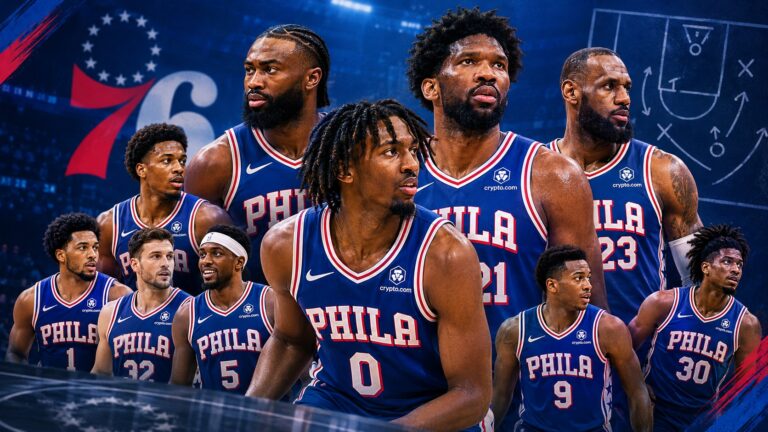
I analyzed player and lineup data to figure out a complete 48 minute gameplan and rotation for the Philadelphia 76ers. I made a custom percentile for guards and another one for big man to compare players. This made it easier and better to see what a player is good at and filters out noise. I also filtered out players who didn’t play enough games and players who didn’t play enough minutes in a game.
For lineup dat I used BBall index stabilized lineup date. This allowed me to also look at smaller lineup data as hot or cold shooting streaks get normalized.
Making a full rotation is hard enough as it is, but The 76ers where even harder to analyze as the team looks so, so different from last season. LeBron and Brown especially will change this team so much. It was fun to look at though. Because we are so early in the season, this will very likely be wrong. This is not yet someting that should 100% work, part of it is testing what lineups could and should work together so we can quickly build a gameplan that does work long term. I think this is a good starting point.
Philadelphia’s starting lineup is the easy part. The more important question is what happens when Tyrese Maxey and Joel Embiid sit.
For a roster built around Maxey, Embiid, Jaylen Brown and LeBron James, the goal should not be to play all four together for as long as possible. It should be to make sure their individual strengths remain useful throughout the game.
That means preserving the Maxey-Embiid partnership, giving LeBron a meaningful role organizing the second group, and providing Brown with enough offensive support that every bench possession does not become his responsibility.
My proposed rotation uses ten players, keeps at least two of those four stars on the floor at all times, and never changes more than two players in a single substitution window.
The starting lineup gets extended stretches at the beginning and end of each half. Between those stretches, the rotation is built around complementary partnerships rather than a traditional starters-versus-bench split.
The minutes: Three players at 32, Embiid at 28
These are targets for a competitive, non-overtime game when the main rotation players are available. They are not rigid season averages or instructions to leave players on the floor regardless of the score.
| Player | First quarter | Second quarter | Third quarter | Fourth quarter | Total |
| Tyrese Maxey | 8 | 8 | 8 | 8 | 32 |
| Jaylen Brown | 8 | 8 | 8 | 8 | 32 |
| LeBron James | 9 | 7 | 9 | 7 | 32 |
| Joel Embiid | 7 | 7 | 7 | 7 | 28 |
| VJ Edgecombe | 6 | 8 | 6 | 8 | 28 |
| Anfernee Simons | 4 | 7 | 4 | 7 | 22 |
| Dean Wade | 5 | 5 | 5 | 5 | 20 |
| Adem Bona | 5 | 5 | 5 | 5 | 20 |
| Kentavious Caldwell-Pope | 4 | 3 | 4 | 3 | 14 |
| Justin Edwards | 4 | 2 | 4 | 2 | 12 |
| Total player-minutes | 60 | 60 | 60 | 60 | 240 |
The allocation gives Philadelphia several useful features:
- The starting five shares 14 minutes.
- Maxey plays all 28 of Embiid’s minutes alongside him.
- Brown and LeBron share 30 minutes.
- Maxey and Simons overlap for only six minutes.
- Bona plays 16 of his 20 minutes with both Brown and LeBron.
The distinction between total minutes and lineup overlap is important. Having several productive players is only part of building a rotation. Their minutes need to connect in ways that give each group enough creation, defensive coverage and positional balance.
The complete rotation
The first and third quarters follow the same pattern. The second and fourth quarters also follow the same pattern.
Consecutive minutes with an unchanged lineup are grouped together below for readability. Every minute of the game is accounted for.
“KCP” refers to Kentavious Caldwell-Pope, and “Edwards” refers to Justin Edwards.
First and third quarters
| Clock | Five players on the floor | Substitution at the start |
| 12:00–8:00 | Maxey, VJ, Brown, LeBron, Embiid | Starting lineup |
| 8:00–6:00 | Maxey, VJ, Edwards, Wade, Embiid | Edwards for Brown; Wade for LeBron |
| 6:00–5:00 | Maxey, KCP, Edwards, Wade, Embiid | KCP for VJ |
| 5:00–4:00 | Maxey, KCP, Edwards, LeBron, Bona | LeBron for Wade; Bona for Embiid |
| 4:00–2:00 | Simons, KCP, Brown, LeBron, Bona | Simons for Maxey; Brown for Edwards |
| 2:00–0:00 | Simons, Brown, Wade, LeBron, Bona | Wade for KCP |
The opening four minutes belong to the starting five.
At the eight-minute mark, Brown and LeBron leave together, but Maxey and Embiid remain. Philadelphia is not asking a new group to invent an offense. It is changing the supporting players around an established partnership.
The next transition is equally deliberate. LeBron returns as Embiid leaves, then Brown returns as Maxey leaves.
The offensive responsibility moves from one partnership to another without creating an all-bench stretch.
Second and fourth quarters
| Clock | Five players on the floor | Substitution at the start |
| 12:00–11:00 | Simons, Brown, Wade, LeBron, Bona | Keep the group that finished the previous quarter |
| 11:00–8:00 | Simons, VJ, Brown, LeBron, Bona | VJ for Wade |
| 8:00–7:00 | Maxey, Simons, Edwards, Brown, Bona | Maxey for LeBron; Edwards for VJ |
| 7:00–6:00 | Maxey, Simons, Edwards, Wade, Embiid | Embiid for Bona; Wade for Brown |
| 6:00–5:00 | Maxey, Simons, KCP, Wade, Embiid | KCP for Edwards |
| 5:00–3:00 | Maxey, VJ, KCP, Wade, Embiid | VJ for Simons |
| 3:00–0:00 | Maxey, VJ, Brown, LeBron, Embiid | Brown for KCP; LeBron for Wade |
There is no wholesale lineup change at the quarter break.
The group finishing the first quarter starts the second. The same applies between the third and fourth quarters. That gives the Brown-LeBron group a sustained opportunity to establish an offensive rhythm.
Across the full game, the schedule contains 22 substitution windows: ten single-player changes and twelve two-player changes. There are no three-player or five-player resets.
Why Maxey and Embiid should remain connected
The strongest organizing principle in this rotation is simple: every Embiid minute comes with Maxey on the floor.
I would use that continuity to establish a clear offensive identity.
Maxey can initiate the possession, attack before the defense is set and create movement around Embiid. Embiid can operate as a screener, interior target or half-court scoring option without the entire lineup changing around him at once.
The supporting combinations vary, but the main partnership remains intact.
That matters during the first-quarter stretch with Maxey, Edgecombe, Edwards, Wade and Embiid. Brown and LeBron are resting, yet the lineup still has two primary offensive options and defined jobs for everyone else.
My preference would be to keep Edwards and Wade in straightforward supporting roles during those minutes. Take the available shot, move the ball, maintain spacing and avoid turning a possession into unnecessary individual creation.
The purpose of staggering is not merely to leave a star on the floor. It is to leave a functioning offense on the floor.
LeBron and Brown give the second group a clear identity
The Brown-LeBron partnership is the other half of the plan.
They share 30 minutes, including almost the entire stretch when Maxey and Embiid are both resting.
The most important version of that group is:
Simons, Brown, Wade, LeBron and Bona.
I would assign the responsibilities this way:
- LeBron: Primary organizer and decision-maker.
- Brown: Main scoring threat and secondary creator.
- Simons: Shooting threat and additional ball-handling option.
- Wade: Defensive matchup flexibility and low-usage offensive support.
- Bona: Screening, rolling, finishing and interior defense.
The historical lineup data provides useful comparisons, even if it cannot predict the performance of a new group.
Boston’s Pritchard, White, Brown, Hauser and Queta lineup carried a +7.3 listed stabilized net rating over 200 minutes in the 2025-26 dataset.
I would not assume Philadelphia can reproduce that number. What interests me is the structure: Brown alongside additional handlers, off-ball shooting and a center with a defined supporting role.
The proposed Philadelphia unit follows that general approach. Brown does not have to create everything, and LeBron does not have to be the primary scoring option on every possession.
There is a limitation here. Wade should not be treated as a Hauser-level shooting replacement. His catch-and-shoot percentile in the custom wing comparison group was 42.8. Which is still good enough, but not at that same level.
This group therefore needs movement, screening and decisive attacks. Simply placing four players around the perimeter and waiting for LeBron or Brown to solve the possession would waste the intended balance.
Edgecombe’s role
Edgecombe receives 28 minutes because his defensive profile addresses a specific need on this roster.
In the custom guard and wing comparison group, his percentile scores were:
- 79.5 in perimeter isolation defense.
- 97.1 in off-ball chaser defense.
- 89.9 in ball screen navigation.
Those are the attributes I want next to a lineup with several major offensive responsibilities already assigned.
His job is not to prove he deserves a larger role by taking difficult shots. It is to handle demanding perimeter assignments, remain involved offensively and provide another player who can move the possession forward.
The LeBron lineup data offers a relevant comparison.
The Lakers’ Dončić, Reaves, Smart, LeBron and Ayton group had a +5.0 listed stabilized net rating over 188 minutes. That does not establish a direct formula for Philadelphia, but it is a useful example of LeBron playing alongside multiple creators without removing the dedicated perimeter-defense role.
For this rotation, Edgecombe is a major part of filling that role.
His preseason shooting results should not determine whether he gets those minutes. The defensive responsibilities are too important to make that decision on a handful of attempts.
Simons gets 22 minutes, but the overlap with Maxey is controlled
Simons gives this roster a valuable offensive skill, accompanied by a clear defensive concern.
His custom percentile profile included:
- 91.3 in catch-and-shoot three-point shooting.
- 27.5 in perimeter isolation defense.
- 6.9 in defensive eFG% impact.
That points me toward a defined shooting and secondary-creation role, rather than treating him as an automatic closing guard.
The rotation gives him:
- 16 minutes alongside LeBron.
- 18 minutes alongside Brown.
- Six minutes alongside Maxey.
The Maxey-Simons overlap occurs from 8:00 to 5:00 in the second and fourth quarters.
That is the part of the schedule I would watch most closely against opponents capable of repeatedly attacking guard matchups.
There is a useful detail in the final minute of each overlap: the lineup is Maxey, Simons, KCP, Wade and Embiid. Simons remains on the floor, but Caldwell-Pope has replaced Edwards, giving the group a different perimeter-defensive option.
I would not describe Maxey and Simons as an inherently unplayable pairing. Maxey’s own profile included strong off-ball chasing and screen-navigation scores. The concern is whether the opponent can consistently force the matchup it wants, and whether Philadelphia gains enough offensively to justify that exposure.
Six planned minutes is an opportunity to evaluate the pairing, not a commitment to preserve it regardless of the matchup.
Bona’s minutes need support, particularly on the glass
With Hukporti unavailable, Bona receives all 20 minutes behind Embiid in the baseline plan. Though I think there is a good argument to be made for some small ball minutes as well, I did not add that in the base version. I do think small ball minutes could work very well and we should try that out in short periods of like 2 minutes at a time. You could easily do this by subbing out embiid and just not bring back bona at certain moments.
There is evidence that makes the opportunity for bona reasonable.
The Edgecombe, Grimes, Edwards, Barlow and Bona lineup had a +4.8 listed stabilized net rating in 73 minutes. Bona’s individual big-man profile also placed him at 67.1 in both rim protection and rim dFG% versus expected.
The rebounding indicators are more concerning:
- 1.3 in adjusted defensive rebounding success.
- 13.2 in total rebounding impact.
That is why the surrounding lineup matters.
Bona plays 16 minutes with both Brown and LeBron. Every one of his 20 minutes includes at least one of them. Both are good rebounders for their position so this will help. LeBron’s playmaking could also help bring out the best from bona.
I would make helping finish defensive possessions an explicit responsibility for the forwards in those groups. Bona cannot be the only player reacting to a missed shot while everyone else prepares to run.
His offensive role should also remain narrow enough to execute consistently: set useful screens, create a finishing target, make the available pass and avoid unnecessary decisions in traffic.
The 20-minute allocation is a starting point. If fouls, defensive breakdowns or rebounding problems make those minutes unsustainable, the rotation needs an adjustment. 20 minutes could easily be a bit much for him at this point. But I think starting out with this as a base will show us quickly if he is ready for a role like this. If not, we know what and how we need to tweak, and if we need a trade here.
The answer should not automatically be to turn Embiid’s 28-minute plan into a much heavier nightly workload.
Wade, Caldwell-Pope and Edwards have different jobs
These three players should not be treated as interchangeable bench wings.
Wade: Defensive flexibility in meaningful minutes
Wade gets 20 minutes, including substantial stretches alongside both offensive partnerships.
His custom defensive percentile scores were 86.1 in perimeter isolation defense, 92.8 in screen navigation and 83.2 in defensive eFG% impact.
That makes him an important part of the plan even though he is not included in the default closing five.
I would use him to take difficult forward assignments, support defensive switches and reduce the number of possessions in which LeBron has to handle a defensive perimeter responsibility.
Twenty minutes is a meaningful role, but it also creates a trade-off: Philadelphia has fewer minutes of Wade’s defensive flexibility than it would in a more defense-oriented rotation. I did think of increasing his minutes, but I think this is a good starting point. You could easily sub him in slightly earlier and out slightly later in his stints to increase his minutes.
Caldwell-Pope: A defensive assignment, not a reputation-based shooting role
Caldwell-Pope receives 14 minutes.
His isolation-defense and off-ball chasing percentile scores were 78.9 and 79.5, respectively. Those are useful reasons to test him beside the roster’s offensive creators.
His shooting results were much less convincing. I would not assume he supplies high-level spacing simply because that has been associated with his name. However, I do think that this is a much better situation for him than the past few seasons which could very easily improve his shooting number back to a good percentage. If he can do that a bigger role with more minutes is probably the way to go.
For this version of the rotation, he needs to defend his assignment, make quick decisions and convert enough of the available shots to remain useful.
Edwards: Structured opportunities around established creators
Edwards receives 12 minutes in relatively short, defined shifts.
His custom three-point percentile was 63.0, with a catch-and-shoot percentile of 50.0. That provides a reason to give him opportunities as an offensive supporting player.
His defensive profile does not justify assuming he is already a dependable two-way rotation wing, however.
I would give him clear assignments and evaluate whether he can perform them consistently. The goal is to create a manageable role, not to ask him to become a complete solution immediately.
The biggest workload decision is LeBron at 32 minutes
The most important qualification in this plan is LeBron’s total.
Thirty-two minutes is not a light workload. He plays nine minutes in the first and third quarters, followed by seven in the second and fourth. Those nine-minute quarters are split into separate stints, but the overall responsibility remains substantial.
The benefit is clear: LeBron helps organize offense and returns for the final minutes of each half.
The cost is equally clear: this is a larger regular-season commitment and a plan to reduce his workload could be a good one with his age.
I would use 32 as the target for a competitive game when the circumstances support it, not as a minimum that must be reached. Rest nights, lopsided games and availability changes require a different allocation.
The broader principle is to avoid solving every problem with additional star minutes. If the bench needs a different combination, change the combination before automatically extending LeBron or Embiid.
The closing lineup is a default, not a guarantee
The scheduled closing five is:
Maxey, Edgecombe, Brown, LeBron and Embiid.
That group plays the final three minutes of both halves, giving it a meaningful chance to develop familiarity.
Still, I would not confuse the most prominent lineup with the best lineup for every opponent.
Wade should remain a closing option when his defensive matchup value is particularly useful. Simons can be considered for a specific offensive possession when additional shooting is the priority.
The opening plan establishes roles. It should not prevent the coaching staff from responding to what the game is showing.
There is also a spacing question worth watching. Having four major offensive names does not automatically produce ideal off-ball spacing.
I would want the closing group to generate movement, put pressure on the defense and create clear decisions. Standing still and taking turns would reduce the value of having so much creation available.
Who sits outside the main ten?
Dominick Barlow, Jabari Walker, Labaron Philon Jr., Dillon Jones, Jameer Nelson Jr. and Tacko Fall have zero scheduled minutes in this specific baseline rotation.
That does not mean they should receive zero minutes over the season.
Barlow and Walker provide alternative frontcourt combinations. Philon should receive developmental opportunities and consideration when additional ball-handling is needed. The remaining depth players can have roles when availability or game circumstances change.
Hukporti is excluded because of his season-long absence.
I would rather establish clear responsibilities for ten players in a competitive game than distribute small, disconnected shifts across the entire roster.
That does not close the competition. It makes the initial evaluation more coherent.
The final verdict
This plan gives Philadelphia two connected offensive partnerships rather than one loaded starting lineup followed by a difficult survival exercise.
Maxey and Embiid remain together. LeBron and Brown carry the central stretch of each half. Simons gets a defined offensive role, while Edgecombe, Wade and Caldwell-Pope provide different defensive options around the creators.
The starting five receives 14 minutes together, including the final three minutes of each half. No player exceeds 32 minutes, and no substitution changes more than two players.
The uncertainties are real: LeBron’s workload, the spacing of the closing group, the defensive cost of the Maxey-Simons overlap and the reliability of the backup-center minutes.
Those are the questions I would evaluate first.
A good rotation does not eliminate every weakness. It gives each lineup a clear purpose, keeps the main players connected and makes the weaknesses easier to identify and address.
That is what this 48-minute plan is designed to do.