

One of the hardest things to talk about in the NBA is contract value.
Everyone can usually agree that Nikola Jokić is one of the best players in basketball. Everyone can see that Shai Gilgeous-Alexander, Luka Dončić, Giannis Antetokounmpo, Victor Wembanyama and other elite players are worth enormous money. But the more interesting question is not just “Who is good?”
The better question is:
How much should a contender be willing to pay for this level of impact?
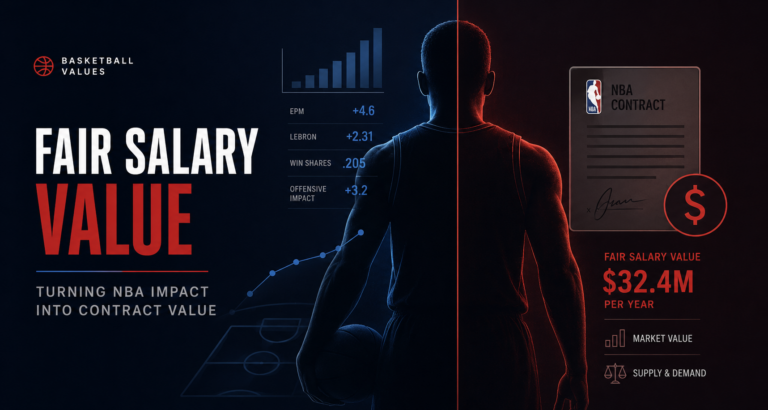
That is what I wanted to explore with my own model: Fair Salary Value
This is not meant to be a perfect contract projection. It is not trying to predict exactly what a player will make on the open market. NBA contracts are shaped by age, leverage, team control, max-salary rules, Bird rights, injuries, positional scarcity, team context and the CBA.
Instead, this model tries to answer a simpler question:
Based on a player’s actual impact and production, what approximate salary would represent fair value for a contender?
In other words: if a serious playoff team is trying to build a championship-level roster, how much could it approximately pay a player before that contract stops being positive value?
You can see every players fairsalary value here:
What Fair Salary Value Is Measuring
Fair Salary Value is built as an impact-to-salary translation model.
The model starts with player performance from the season and converts that performance into a single value score. That score is then translated into a salary number using the projected NBA salary cap as the money anchor.
For this version of the model, the cap anchor is the 2025-26 salary cap: $154.6 million.
So when the model says a player has a Fair Salary of, for example, 40 million, that does not necessarily mean that player will sign for exactly $40 million. It means that, based on the model’s view of his impact, a contender could pay around that amount and still reasonably expect the contract to provide neutral-to-positive value.
If the player is paid much less than that number, he is likely providing surplus value.
If he is paid much more, the contract may be harder to justify from a pure contender-value perspective.
—
This Is Not Just a Box Score Stat
A lot of player value models lean too heavily in one direction.
Some models are almost entirely box-score driven. Those tend to reward volume production: points, rebounds, assists, steals and blocks. That can be useful, but it can also overrate players who put up big numbers without necessarily driving winning.
Other models lean almost entirely on advanced impact metrics. Those can be powerful, but they can sometimes become too abstract or context-dependent for casual readers.
Fair Salary Value tries to sit in the middle.
The model uses two major blocks:
1. Production Block
2. Advanced Impact Block
The final score blends both.
The goal is to reward players who actually produce, create offense, defend, stay available and impact winning — not just players who score a lot or look good in one metric.
—
The Production Side
The production side of the model looks at the things fans are used to seeing:
– Scoring
– Passing
– Rebounding
– Steals
– Blocks
– Turnovers
– Efficiency
– Usage
– Availability
But instead of treating all raw numbers equally, the model adjusts them into standardized values.
That means a player is not only judged by how many points or assists he averaged. He is judged relative to the player pool.
For example, scoring 25 points per game matters. But scoring 25 efficiently, while creating for others, limiting turnovers and playing heavy minutes, matters more.
The production side tries to capture that full picture.
It includes a box-score production backbone, but it also looks at:
Usage and Efficiency
A player who carries a large offensive role while remaining efficient is extremely valuable.
That is different from a player who scores a lot only because he takes a lot of shots.
The model rewards players who combine role size with efficiency.
Playmaking Discipline
Assists matter, but so do turnovers.
A player who creates offense without constantly giving possessions away adds real value to a contender. The model therefore includes an assist-to-turnover component so clean decision-makers get proper credit.
Availability
Availability matters more than people sometimes want to admit.
A player can be excellent on a per-minute basis, but if he is not on the floor enough, his season-long value drops. Contenders need stars and role players who can survive the grind of an 82-game season and be trusted with meaningful minutes.
So the model includes a workload/availability component based on games played and minutes played.
—
The Advanced Impact Side
The advanced side of the model brings in impact metrics that are designed to estimate how much a player contributes to winning beyond the basic box score.
This version uses a blend of advanced indicators such as:
– LEBRON
– VORP
– Win Shares per 48
– BPM
– PER
No single advanced stat is perfect. Each one has strengths and weaknesses.
That is why the model does not rely on just one number. Instead, it blends several of them together to create a broader advanced-impact profile.
This helps separate players who simply put up counting stats from players whose minutes are actually associated with winning basketball.
For a contender-value model, that distinction matters a lot.
—
Why Everything Gets Standardized
One important part of the model is that every major category is standardized before being blended.
That means the model converts different statistics into the same language.
Points per game, true shooting percentage, VORP, BPM and availability all live on different scales. You cannot simply add them together without adjustment.
So the model compares players to the population average in each category and measures how far above or below average they are.
This helps answer questions like:
– How far above average is this player as a producer?
– How far above average is he as a creator?
– How far above average is he in advanced impact?
– How much does availability help or hurt his value?
Once everything is on the same scale, the model can blend those areas more fairly.
From Impact Score to Salary
After the production block and advanced block are created, they are blended into one final score: the player’s Contract Value Score, or CVS.
The model then translates CVS into a percentage of the salary cap.
That cap percentage becomes the player’s Fair Salary.
So the basic process looks like this:
1. Collect player production and impact data
2. Standardize each metric relative to the player pool
3. Build a production score
4. Build an advanced impact score
5. Blend them into one Contract Value Score
6. Convert that score into a salary-cap share
7. Convert the cap share into a dollar value
The result is the player’s Fair Salary Value.
Again, this is not meant to be a legal CBA salary. It is an estimated value number.
That is especially important for the very top players.
Some superstars produce value far above what they are allowed to earn because of max-contract rules. In those cases, a Fair Salary number above the maximum salary should be read as:
This player is so valuable that even a max contract would likely be positive value.
That is why the best players in the league can show Fair Salary numbers that are higher than what the CBA would actually allow them to be paid.
—
Reading the Results
There are three salary outputs in the model:
1. Balanced Fair Salary
This is the main number and the main way to use Fair Salary as a model.
It blends advanced impact and production together, with advanced impact weighted slightly more because this is a contender-value model and because defense is measured better in advanced stats. The goal is not just to reward volume, but to reward winning impact.
Most of the time I think this version of the model gives you a good indication of what a player should ideally be making. However in some situations it doesn’t completely show what the value for a player should be. Sometimes it over, or undervalues players. So I decided to add 2 variations of fair salary to give you a better range of salary indication. Most of the time, all 3 variations will look a bit similar, which is when you can fairly confidently say that is a salary that a player should get. Though sometimes there is a bit of a difference and we should take more context into account. I noticed this mostly happens with players who didn’t get too much playing time or played games which makes them harder to rank. And with good players on bad teams. Where their advanced stats were sometimes negatively affected.
2. Advanced-Heavy Fair Salary
This version gives more weight to the advanced impact side.
It is useful for identifying players whose value may not fully show up in the traditional box score. Defensive players, low-usage connectors, elite efficiency players and high-impact role players often look stronger here.
3. Production-Heavy Fair Salary
This version gives more weight to raw production, role size, usage, creation and availability.
It is useful for identifying players who carry large offensive burdens or pile up real production, even if the advanced metrics are less enthusiastic. Or to discount players who played well but were often injured.
Looking at all three numbers gives a better picture than looking at only one.
For example, if a player has a much higher production-heavy salary than advanced-heavy salary, the model may be saying:
This player produces a lot, but the impact metrics are less convincing.
If a player has a much higher advanced-heavy salary than production-heavy salary, the model may be saying:
“This player impacts winning more than his traditional stat line suggests.”
That gap is often just as interesting as the final Fair Salary number itself.
The Top of the Model
At the very top, the model identified the obvious superstar-level players.
Players like Nikola Jokić, Shai Gilgeous-Alexander, Victor Wembanyama, Luka Dončić, Giannis Antetokounmpo and Kawhi Leonard graded as max-tier or above-max value players.
That makes sense.
These are the types of players who shape an entire team’s title chances. They are not just good starters. They are roster-architecture players. If you have one of them, your whole team-building plan changes.
For these players, Fair Salary Value is less about whether they are “worth the max.” They obviously are.
The more useful takeaway is that the very best players are often worth significantly more than their actual maximum salary.
That is one of the biggest advantages in the NBA: having a true superstar whose on-court value exceeds what the CBA allows him to be paid.
That is how championship surplus is created.
Example: Nikola Jokić
Nikola Jokić finished at the top of the model.
That should not be surprising.
He combines elite scoring efficiency, historic playmaking, strong rebounding, massive offensive responsibility and elite advanced impact. He is the type of player who breaks normal valuation systems because his value is not limited to one category.
He is not just a scorer.
He is not just a passer.
He is not just an efficient big.
He is an entire offensive ecosystem.
The model’s Fair Salary number for Jokić came out far above a normal maximum salary. That does not mean a team can actually pay him that amount under NBA rules. It means his impact is so large that a max contract is still a bargain.
In simple terms:
Jokić is not just worth a max contract. He is worth more than the max.
Example: Shai Gilgeous-Alexander
Shai also graded as one of the most valuable players in the league.
His profile is exactly what a contender-value model should love: elite scoring, elite efficiency, strong creation, defensive activity, availability and massive impact.
He is a high-usage superstar who does not sacrifice efficiency. That combination is extremely rare.
A lot of players can create offense if you give them enough possessions. Very few can do it at Shai’s level while also maintaining elite efficiency and two-way value.
That is why his Fair Salary number lands in the absolute top tier.
Example: Victor Wembanyama
Wembanyama’s placement near the very top is one of the most interesting parts of the model.
His value is unique because he combines high-level production with extreme defensive impact. Players who can score, rebound, protect the rim, create matchup problems and alter the entire geometry of the floor are incredibly rare.
Wembanyama’s advanced indicators and defensive profile push him into the highest tier very quickly.
The model sees him not just as a future superstar, but as someone whose impact already belongs in the league’s most valuable group.
The Star and High-Level Starter Range
After the very top tier, the model gets into the star and high-level starter range.
This is where contract evaluation becomes more interesting.
Superstars are easy. If a true MVP-level player is available, you pay him.
The harder decisions are with players in the $25 million to $50 million Fair Salary range.
This is where teams have to decide:
– Is this player a true star or an elite role player?
– Is his production scalable in the playoffs?
– Does he fit next to other high-usage players?
– Is he worth a near-max salary?
– Does his impact justify his role?
– Is he more valuable to a contender than to a rebuilding team?
Players in this range can swing roster construction.
A $35 million player who performs like a $45 million player is a huge advantage.
A $35 million player who performs like a $20 million player can quietly damage a contender’s flexibility.
That is why Fair Salary Value can be useful. It gives a rough estimate of whether a player’s impact lines up with the type of money usually attached to his role.
Why Contender Value Is Different From General Value
This model is specifically framed around contender value. It tries to build a picture for you, the fans, to show what a player approximately could reasonably earn to bring value on a contender.
That matters.
A rebuilding team and a contender may value the same player differently.
A rebuilding team might care more about:
– Age
– Upside
– Development reps
– Shot creation flashes
– Long-term team control
– Trade value
A contender might care more about:
– Reliability
– Efficiency
– Defense
– Decision-making
– Playoff scalability
– Ability to fit next to stars
– Availability
– Mistake avoidance
Fair Salary Value leans more toward the contender side.
That is why the model rewards players who can help good teams win. It does not only reward players who can put up numbers on bad teams.
For example, a low-usage defensive player who spaces the floor, avoids mistakes and has strong impact metrics may grade better than his box score suggests. That is intentional.
On a contender, those players matter.
Interpreting Surplus Value
The easiest way to use the model is to compare a player’s Fair Salary to his actual salary.
If a player’s Fair Salary is higher than his real salary, he is creating surplus value.
If his Fair Salary is lower than his real salary, he may be overpaid relative to his modeled impact.
For example:
Positive Value Contract
If a player makes $18 million but has a Fair Salary of $30 million, the model sees him as a strong value.
That type of contract helps a contender because the team is getting more impact than it is paying for.
Neutral Value Contract
If a player makes $30 million and has a Fair Salary around $30 million, the deal is roughly fair.
The player is being paid about what his impact suggests.
Negative Value Contract
If a player makes $40 million but has a Fair Salary of $20 million, the model sees the contract as negative value.
That does not mean the player is bad. It means the salary may be too high for the level of impact he provided.
That distinction is important.
A player can be good and still be overpaid.
A player can be limited and still be an excellent value.
—
Why Some Role Players Can Look Very Valuable
One thing people may notice is that some role players grade surprisingly well.
That is not necessarily a mistake.
Contenders need more than stars. They need players who can survive playoff basketball.
The model can reward role players who provide combinations of:
– Strong efficiency
– Low turnovers
– Defensive impact
– High availability
– Good advanced metrics
– Scalable offensive roles
These players may not average 20 points per game, but they can still be worth real money because they help lineups function.
A player who defends, spaces the floor, makes quick decisions and does not need the ball can be incredibly valuable next to stars.
That is why a contender-value model should not simply rank every high-volume scorer above every role player.
Basketball value is contextual.
Why Some High-Volume Scorers May Grade Lower
The opposite can also happen.
Some players who score a lot may not grade as highly as expected.
Usually, that happens when the model is less impressed by their overall impact profile.
Possible reasons include:
– Below-average efficiency
– Weak advanced impact numbers
– Poor defensive value
– High turnovers
– Limited playmaking
– Low availability
– Production that does not translate into winning impact
This is one of the reasons I wanted the model to blend production with advanced impact.
Raw scoring matters. But scoring alone does not define contract value, especially for a contender.
If a player needs high usage, does not defend, does not create efficiently for others and does not lift lineups, then his salary value should not automatically match his points per game.
Why Availability Matters
Availability is one of the most underrated parts of contract value.
A player who is great for 35 games can still be extremely valuable, but his regular-season contract value should not be treated the same as a player who provides similar impact over 70 games.
Contenders need players who can help secure seeding, build chemistry and reduce the burden on other stars.
This does not mean injured players are “bad.” It simply means missed time affects season-long value.
The model reflects that.
Availability is not everything, but it is part of the equation.
The Importance of Salary Cap Context
One reason I wanted to convert impact into salary is that NBA money changes over time.
A $30 million salary today does not mean the same thing it meant 10 years ago.
That is why the model uses salary-cap share.
Instead of thinking only in raw dollars, it asks:
What percentage of the cap is this player’s impact worth?
Then that percentage is converted into a dollar value using the current cap anchor.
This makes the model easier to update in future seasons.
If the salary cap rises, the same level of impact would translate into a higher dollar amount.
That is how real NBA contracts work too. Salaries should always be viewed relative to the cap environment.
Apron Context
The model also includes first-apron and second-apron context.
The apron numbers are not part of the value calculation itself. They are there to help frame roster-building pressure.
That matters because the modern NBA punishes expensive teams more heavily than ever.
A player might be “worth” a certain salary in isolation, but once a team is near or above the second apron, every extra dollar becomes more painful.
So Fair Salary Value can help ask two different questions:
1. Is this player worth his salary based on impact?
2. Can this team afford that salary within its roster-building structure?
Those are related questions, but they are not the same question.
A contract can be fair in a vacuum and still be difficult for a second-apron team.
Tiers Instead of Exact Answers
Even though the model gives exact dollar amounts, I do not think people should treat them as perfectly exact.
A player listed at $31 million is not meaningfully different from a player listed at $32 million.
The better way to read the model is through tiers.
The general idea is:
Max-Tier / Above-Max Value
Players whose impact is so high that a max contract is likely positive value.
These are franchise-changing players.
Star Value
Players who can justify major salaries because they produce or impact winning at a high level.
These are usually primary or secondary stars, or elite two-way players.
High-Level Starter Value
Players who are clearly valuable starters and can be important pieces on good teams.
These players may not be superstars, but they can still justify significant money.
Starter Value
Players who provide enough impact to be viewed as quality starters or strong rotation pieces.
Role Player Value
Players who can help, but whose value depends more heavily on role, fit, price and team context.
This tier approach is more useful than arguing over every individual dollar.
What the Model Does Well
I think Fair Salary Value is useful because it creates a bridge between performance and roster construction. Especially for the (casual) fan that wants an indication of what a player should be making.
It helps put player impact into a language every NBA fan understands:
Money.
Instead of saying “this player had a good BPM” or “this player had strong production,” the model asks:
What would that impact be worth against the salary cap?
That makes comparisons easier.
It can help identify:
– Underpaid stars
– Overpaid high-volume players
– Valuable role players
– Strong contender fits
– Players whose impact exceeds their box score
– Players whose production may overstate their value
– Contracts that create surplus value
– Contracts that limit flexibility
– How much a player could get in free agency.
It also gives a clearer way to discuss team-building.
A championship roster is not just about having good players. It is about getting enough impact per dollar.
What the Model Does Not Do
No model can capture everything.
Fair Salary Value does not perfectly account for:
– Age curve
– Future projection
– Injury risk going forward
– Playoff matchup-specific value
– Locker-room value
– Leadership
– Contract leverage
– Bird rights
– Free-agent scarcity
– Team option value
– Rookie-scale surplus
– No-trade clauses
– Positional market inflation
– Exact CBA max-salary rules
– How a player would perform in a totally different role
That is important.
A young player with a modest Fair Salary number may still be extremely valuable because of upside.
An older player with a strong Fair Salary number may not get that amount on the market because teams worry about decline.
A player on a rookie contract can create massive surplus even if his current Fair Salary is not superstar-level.
So this should not be read as a complete front-office decision-making tool.
It is one lens.
A useful lens, but still one lens.
How I Would Use Fair Salary Value
The best way to use this model is not to say:
“The model says this player is worth exactly $37.4 million.”
The better way to use it is:
“The model sees this player as roughly a $35-40 million impact player in this cap environment.”
That range-based thinking is much more realistic.
Contract value is never exact.
The model is most useful when comparing players in similar roles or salary ranges.
For example:
– Which max players are actually giving max-level impact?
– Which near-max players are closer to high-level starters than true stars?
– Which role players are providing starter-level value?
– Which players are being paid for production that does not fully translate to impact?
– Which players would be most valuable to a contender?
Those are the kinds of questions this model is built to explore.
—
Final Thoughts
Fair Salary Value is my attempt to turn NBA impact into a contract-value language.
It takes production, efficiency, creation, availability and advanced impact, blends them together, and converts the result into a salary-cap-based number.
The goal is not to replace scouting or context.
The goal is to create a clearer starting point for contract conversations for fans.
In the NBA, value is not just about how good a player is.
It is about how much impact he provides relative to what he costs.
That is what championship team-building is built on, especially in today’s NBA.
A contender needs stars, but it also needs surplus value. It needs players who outperform their contracts to win a championship. It needs role players who scale next to stars. It needs to avoid paying good-player money for average impact. And it needs to understand when a superstar is so valuable that even a max contract is a bargain.
That is the purpose of Fair Salary Value.
It is not a perfect answer.
But it is a way to ask a better question:
Based on what this player actually gave you, how much should a contender have been comfortable paying him?
And that, to me, is one of the most important and interesting questions in modern NBA roster building.